Why Does Nobody Read Party Platforms? Because We Don't Vote for a Party, We Vote for a Tribe
What two studies we ran on the eve of the 2015 and 2019 elections reveal about the link between our deepest values and the ballot we cast, and why the key to that link lies in parties that do not exist.
Every election season, parties pour fortunes into platforms, economic plans and position papers. But how many of us actually read them? We like to think of ourselves as rational voters who weigh policy on the economy, security, and religion and state. Psychology offers a more basic explanation. Beneath our political positions runs a far deeper and more stable operating system: our values. In two studies conducted in two different election campaigns, we set out to understand how this inner compass leads us to the ballot box. The answer we found is both simple and surprising: we don't vote for a platform, we vote for a tribe.
The Operating System Beneath the Surface
Social psychologist Shalom Schwartz developed one of the most influential theories in the study of values, the Theory of Basic Human Values. According to the theory, values are broad goals that guide us throughout life, and they are arranged in a circle of four higher-order values. One axis sets conservation values (security, tradition, conformity) against openness to change (freedom, independence, curiosity). The other axis sets self-transcendence (caring for others, equality, tolerance) against self-enhancement (achievement, power, success). The idea behind the circle is simple: what sits close together fits together, and what sits on the opposite side clashes.
Values are not passing opinions. They are stable over time, form early in life, and shape our choices in almost every domain. But when you try to test how they shape the vote, you run into a problem. A real party is a crowded package deal: a charismatic or divisive leader, a history, a group identity, scandals and memories. When someone supports Likud or Meretz, it is hard to isolate what exactly draws them there.
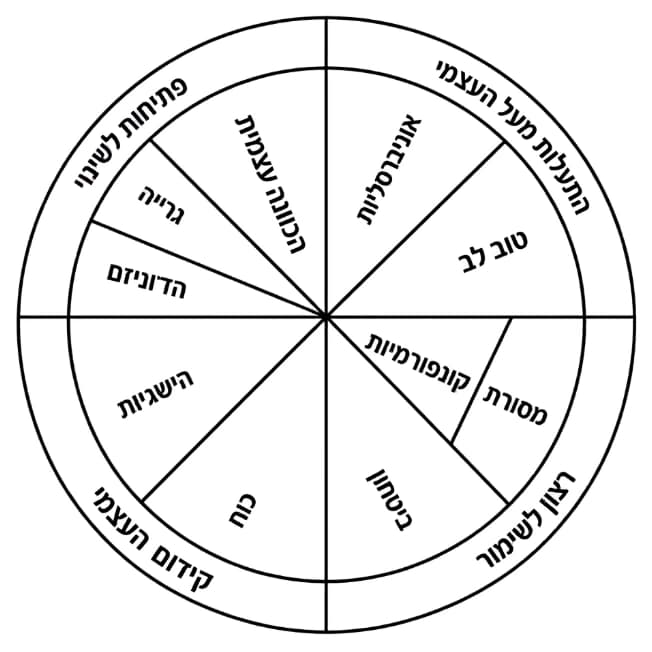
So in the study I conducted with the late Prof. Sonia Roccas, we decided to strip away the noise. We built five fictional parties, pure value "tribes" of a sort, each with a platform expressing a single core value:
Party A
The Conservation Tribe
A platform about security, order and preserving tradition.
Party B
The Power and Achievement Tribe
A platform about prosperity, excellence and positions of influence.
Party C
The Openness and Innovation Tribe
A platform about freedom of action, creativity and initiative.
Party D
The Caring-for-Others Tribe
A platform about helping others, honesty and mutual responsibility.
Party E
The Universalism Tribe
A platform about equality, tolerance, peace and the environment.
We asked participants in two election campaigns (on the eve of the 2015 election and of the April 2019 election) to complete a values questionnaire, to rate how much they liked each fictional party, and then to rate the real parties: how much they support each one, and how similar each real party is to each of the five tribes.
Five Tribes in Theory, Only Two at the Ballot Box
The first stage showed that the compass works: people were strongly drawn to the fictional party that expressed their personal values, and recoiled from the one expressing opposing values. Those who prize conservation liked Party A and rejected the universalism party, and vice versa. Even when we asked participants to build an "ideal party" by dividing percentages among the five tribes, Schwartz's circular structure surfaced right away.
But the real surprise came when participants placed the real parties on the map. Out of five possible value tribes, it turned out that Israeli politics funnels almost entirely into just two:
The conservation camp
Likud, Shas, the Jewish Home, Yisrael Beytenu and United Torah Judaism were all seen as most similar to the conservation tribe.
The universalism camp
The Zionist Union, Meretz and the Joint List were seen as most similar to the universalism tribe.
In other words, the value map of Israeli politics is not a multidimensional space. It is a single axis: conservation versus universalism. Core human values such as achievement, openness to change or everyday kindness, which in theory could give rise to entire parties, barely play a role in Israel's political game.
Why Don't We Really Need to Read Platforms?
In the 2019 campaign we examined a deeper question: how exactly does an inner value translate into a ballot? We found that the link between values and support for the real parties runs through liking for the tribes. People essentially ask themselves first, "Is this my tribe?", and only then decide whom to support.
Across the main parties on the axis (Likud, the New Right, the Union of Right-Wing Parties, Blue and White, Labor and Meretz), once we accounted for how connected a voter felt to the conservation tribe and to the universalism tribe, the direct link between personal values and party support weakened sharply, and in some cases almost vanished. In Likud's case, for example, values and tribe liking together explained about forty percent of the differences in support. The meaning is simple: the voter does not need to read a platform. The tribe works as a mental shortcut. It is enough for the voter to recognize the party's "tribe label" to know whether it fits their value operating system.
When Identity Beats Ideology, and What "Floating Votes" Really Look Like
There was only one place where this mechanism worked differently: the ultra-Orthodox parties. For Shas and United Torah Judaism, tradition values predicted support directly, without passing through any of the fictional tribes. The reason is that these are parties of community and identity. Voting for them expresses belonging to a defined way of life, not a search for an ideological match between an abstract value and a political platform. Tradition here is not a plank in a platform; it is the world people live in.
And what about voters who do switch parties? When we compared voters who voted for the same party in 2019 as in 2015 with voters who moved to another party, we found that their values barely differed from those who stayed loyal. Most moves happened within the blocs: from the Zionist Union to Blue and White, or among the various right-wing parties. Values determine which tribe we belong to, and within our tribe's borders we feel free to wander between political brands. The parties change, but the tribes remain.
In the end, the consistent pattern that repeated in two different election campaigns holds up a sharp mirror to Israeli politics. Elections in Israel are not a contest between work plans but a face-off between two value tribes: the conservation tribe and the universalism tribe. The floating votes that campaigns fight over move mostly within the tribe, not between tribes. A campaign that tries to persuade a voter to cross the tribal line is fighting that voter's deepest value compass, and that is a battle almost impossible to win with promises and platforms. Next time you stand in front of the ballot tray, it is worth asking not only who promises what, but which tribe you belong to, and why.
So What Does This Mean for October 27?
In less than three weeks we will head to the polls again, this time for the 26th Knesset. Some 38 lists are running, some entirely new and some mergers and splits of familiar parties. If our findings still hold today, most of this drama is happening within the tribes, not between them. That suggests three lenses for reading the current campaign:
Every new list is judged by its tribe first
Before voters ask what a list offers, they ask which tribe it belongs to. Lists that try to sit "in the middle", without a clear conservation or universalism label, may struggle to attract supporters, even when their candidates are well known and well liked.
The big swings in the polls are mostly within the bloc
Seats moving between lists of the same camp make headlines, but they do not change the balance of power. The outcome depends on a much smaller group of voters willing to cross the line between the tribes, and on how many members of each tribe actually turn out to vote.
The ultra-Orthodox parties follow a different logic
Voting for them rests on community and way of life, so it is likely to be relatively stable and less sensitive to the campaign, the platform or the polls.
It is worth remembering that our data were collected in 2015 and 2019, before the protests over the judicial overhaul, before October 7 and before the war. These events may have shifted the tribal map: perhaps they increased the weight of security values, which belong to the conservation tribe, and perhaps they even created a new fault line that did not exist before. That is exactly the question worth examining now.
Meanwhile, my bet is simple: on October 27 most of us will not read platforms. We will recognize our tribe, pick the list within it that speaks to us best, and cast a ballot. The truly interesting question is not only who will win, but how many voters will dare to cross the line.